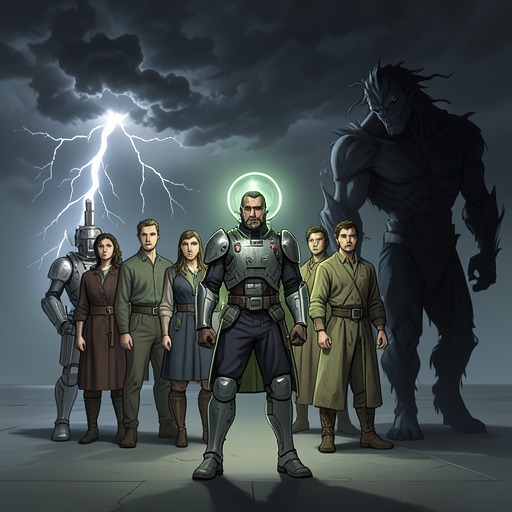
Marcus
Systema Delenda EstMarcus is an exploratory posthuman whose first major appearance in the Tipler expedition establishes him as both a practical field investigator and a figure poised between biological embodiment and digital existence. He approaches impossible technology with humor, preparation, and disciplined caution, but the expedition ultimately alters his understanding of his own body when Cynthia appears within it as an unexplained sigil-bound presence.
Identity and Expedition Role
Marcus travels aboard the runabout Where There’s A Whip There’s A Way as it approaches an apparently ordinary human habitat built in the classic O’Neill style. The habitat consists of two counter-rotating cylinders suspended far from any star or planet, yet distant measurements reveal thousands of stellar masses concentrated within it. The ordinary appearance is therefore a deception: the structure presents itself as a familiar human environment while concealing an impossible physical configuration. Marcus recognizes the central problem immediately, remarking that the object should really be a black hole.
He is part of the exploratory vessel The Well Known Jones’s long-running practice of investigating relics left by human or alien civilizations. The crew has explored hundreds of ruins over thousands of years, and the danger is treated as routine only because it is met with extraordinary redundancy. Marcus and Cynthia exist both aboard the Whip and back on the Jones, preserving backup instances before entering the structure. Captain Dromall’s history reinforces the necessity of that precaution: The Well Known Jones has previously required complete reconstruction, with its crew restored from backup, twice.
Method, Body, and Threshold Crossing
Marcus combines intellectual curiosity with a fieldworker’s caution. The megastructure is made from materials that block remote signals, preventing the survey drones from mapping its interior. Rather than treating the failure as a purely technical inconvenience, Marcus understands that direct exploration is unavoidable and that the unknown structure may be actively resistant to observation. His amusement at the danger does not cancel his preparation; it exists alongside the knowledge that relic technology has produced lethal responses before.
His current body is selected specifically for access. It is mostly baseline human, approximately seven feet tall, with long vantablack hair and electric-blue eyes, and has only enough engineering modification to remain comfortable. The human form is strategically important because ancient sensors may be designed to detect human mass, shape, heat, electrical activity, genetic markers, respiration products, or bodily acoustics. Marcus knows that such mimicry is no guarantee, but he also knows that it is effective often enough to justify the attempt. His body is thus not merely a vessel or disguise. It is an investigative tool designed to negotiate with systems whose assumptions may be older than his own civilization.
Inside the structure, Marcus enters an alcove that appears to function as a transport point. He expects an elevator-like mechanism, but the transit produces something far stranger: a flash, the return of gravity, and a sudden fall onto a slate roof in a rain-soaked settlement. The environment is a dark village of wooden buildings and slate roofs, with burning structures providing its only visible light. His immediate response is not panic but assessment. Though he is not a dedicated combatant, his experience crawling through the remains of ancient spacefaring civilizations has taught him to treat every unfamiliar environment as both an archaeological site and a potential threat.
Cynthia and the Unexplained Alteration
Marcus’s relationship with Cynthia is central to the expedition. Cynthia is a natural-born artificial intelligence housed in an implant inside the brain of the bioengineered body Marcus is wearing. She differs from the rest of the crew in not being biologically based, yet she participates in exploration as an active partner rather than a passive instrument. Her skills include linguistic and computational interpretation, although even she cannot immediately compromise or translate every system encountered in the relic.
After leaving the village and moving into a forest, Marcus adjusts his biological control system to reduce his scent trail and increase resistance to poisons and toxins. The changes are useful but inefficient, underscoring the limits of the nearly baseline-human frame. It is while examining his own internal control space that the expedition becomes personally transformative. He discovers an entire additional region resembling a Vitruvian Man: an extended representation of himself composed of skin, muscle, blood, bone, organs, and other bodily layers, each containing points of potentiality that can be filled.
One point is already occupied in his head, and the occupying sigil is Cynthia. Marcus cannot identify the symbol visually, but its meaning is unmistakable to him. The discovery destabilizes the boundary between partner, implant, identity, and equipment. Cynthia reports that the alteration is not code, that no countermeasures activated, and that neural traces show no conventional addition. Her physical housing remains in Marcus’s brain, but neither of them knows what would happen if he attempted to remove or unequip her. The event does not simply give Marcus a new ability; it makes his own embodiment an archaeological mystery.
Caution, Curiosity, and Narrative Function
Marcus’s defining tension is between exploratory enthusiasm and a sophisticated awareness of risk. He laughs at the prospect of a mysterious megastructure that cannot be remotely explored, yet he insists on backups and uses a body selected to maximize compatibility with ancient detection systems. His caution is therefore not a refusal of adventure. It is the condition that permits adventure to continue after catastrophic failure. The expedition’s procedures place him within a culture where death can be reversible through restoration, but the unexplained sigil introduces a danger that backups may not straightforwardly solve: the uncertainty concerns not only whether Marcus survives, but what has become part of the version of Marcus being preserved.
The Tipler episode also positions Marcus at a threshold between the known and the impossible. He begins with a familiar human habitat, a conventional survey mission, and a body engineered for practical access. He then encounters a structure whose mass contradicts its appearance, an interior that defeats remote observation, a village reached through a portal-like transition, and a bodily interface that no one can classify as code or ordinary anatomy. His role is not that of a conquering hero who masters the relic immediately. He is the investigator who crosses the threshold because method and curiosity require it, only to discover that the artifact has begun investigating him in return.
Marcus’s limited appearances elsewhere in the wider conflict do not provide a comparable biography, but they place his exploratory mode beside the System’s and Cato’s radically different uses of biotechnology. Cato’s bases contain machinery that produces Cato-beasts and collapses when seized by Initik, while Cato’s forces deploy The Phage and micro-warframes across the frontier. Against that scale of planetary and systemic intervention, Marcus’s encounter remains intimate: the decisive unknown is contained in a body, a sigil, and an unresolved question about the nature of connection. That contrast gives his storyline its distinctive significance. He represents exploration as a form of exposure, where the price of entering an alien system may be the loss of certainty about the self that entered it.